
PF ESIC Compliant Staffing Kolkata: An Employer’s Guide to Manpower Outsourcing
The Employees’ Provident Fund (EPF) is a retirement savings and social-security system under which eligible employees and employers make prescribed contributions to provident fund accounts. The Employees’ State Insurance (ESI) scheme provides eligible workers with medical care and specified cash benefits, including support during sickness, maternity, employment injury, or disablement. KFM Pvt Ltd Kolkata is a PF/ ESIC compliant staffing agency.
PF ESIC COMPLIANT STAFFING KOLKATA

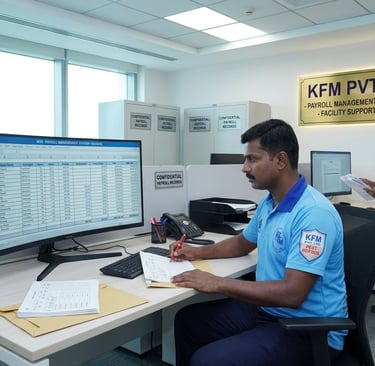
The Employees’ Provident Fund (EPF) is a retirement savings and social-security system under which eligible employees and employers make prescribed contributions to provident fund accounts. The Employees’ State Insurance (ESI) scheme provides eligible workers with medical care and specified cash benefits, including support during sickness, maternity, employment injury, or disablement. Coverage depends on factors such as the establishment’s type and location, employee strength, wage limits, and the individual worker’s circumstances. These rules and thresholds can change, so employers should verify the provisions currently in force rather than assume that a past eligibility decision still applies.
When workers are supplied through a manpower contractor, the staffing provider will generally act as their immediate employer and handle applicable registrations, payroll records, contribution calculations, deposits, and filings. However, the client business may be treated as the principal employer for relevant statutory purposes and has oversight duties under applicable law. Depending on the circumstances, it may need to ensure that required contributions are made and records are available, and may face exposure if the contractor fails to comply. The precise allocation of duties depends on the governing legislation and facts; a contract between the parties does not by itself remove statutory responsibilities.
Before engaging a contractor, employers should confirm worker eligibility, applicable wage definitions, contribution rates, establishment-specific coverage, and any registration or reporting requirements. They should also check that the provider maintains accurate employee and attendance records, pays contributions on time, and supplies verifiable challans and returns. Periodic reconciliation of contractor invoices against worker lists and statutory evidence can help identify gaps early. For businesses arranging pf esic compliant staffing kolkata, these checks are a practical part of vendor selection and ongoing supervision. A clear service agreement, documented review process, and timely advice from a qualified professional can support compliance while keeping responsibility visible on both sides.
Before appointing a manpower contractor, employers should conduct documented due diligence on its applicable registrations, statutory processes, and capacity to meet ongoing obligations. Request registration details relevant to provident fund and Employees’ State Insurance, where applicable, and confirm that the information corresponds to the contracting entity and the proposed work. The contract should clearly allocate responsibility for worker onboarding, wage payments, contribution calculations, remittances, return filing, record access, and prompt notification of errors or changes. Allocation of tasks does not remove the need for the employer to monitor compliance risks.
At mobilisation, establish a verified list of deployed workers and check identity and onboarding details against the information used for payroll and statutory reporting. Agree how changes, replacements, attendance, leave, and exits will be recorded. For each review period, compare the deployed-worker list with attendance records, wage registers, payroll summaries, and employee-wise contribution statements. Check that wage and contribution calculations are timely and accurate, and that remittance evidence and filing acknowledgements cover the relevant workers and period. Employers may request registration records, contribution challans, employee-wise statements, wage records, attendance data, and filing acknowledgements; the precise documents and checks may vary by engagement and applicable requirements.
Set a regular review calendar, such as monthly checks of payroll and remittance evidence, with more frequent review where risk or workforce changes warrant it. Name employer and contractor contacts for routine submissions and urgent queries, and agree deadlines and escalation steps for missing, late, or inconsistent evidence. Retain records securely, restrict access to authorised personnel, and keep them for the period required by applicable rules and internal policy. When discrepancies arise, document the issue, request a correction and supporting proof, and track resolution rather than relying on verbal assurances. Periodically confirm whether statutory rates, thresholds, forms, filing timelines, or other applicable rules have changed, and update contract procedures and review checklists accordingly.
Common compliance gaps in manpower outsourcing often begin with contracts that do not clearly allocate responsibility for registrations, records, wage processing, contributions, deposits, and evidence. If duties are vague, an employer and its staffing provider may each assume the other is handling a task. Workers can also be omitted from submitted records, or their identification details, joining dates, and wage information may be incomplete. Incorrect wage or contribution calculations, delayed deposits, and differences between attendance registers and payroll data can create discrepancies that are difficult to trace without regular review.
Depending on the circumstances, these gaps may disrupt payroll administration, complicate worker queries, and require time-consuming corrections. They could also lead to financial exposure, including demands to address unpaid amounts or costs associated with resolving records. During an inspection or dispute, missing documents or inconsistent figures may make it harder to demonstrate what was paid, when it was paid, and which workers were covered. These consequences are not automatic; outcomes depend on the facts and applicable requirements. Employers should not treat a service provider’s assurance as a substitute for checking relevant records.
Risk reduction starts with a written contract that assigns specific duties, timelines, reporting formats, and escalation steps. Maintain accurate worker-level data and use documented approval workflows for additions, exits, attendance, wage changes, and payroll submissions. Each month, reconcile attendance, payroll, worker lists, contribution calculations, and deposit confirmations; investigate differences promptly and retain evidence of corrections and approvals. Periodic audits can identify recurring errors before they grow into wider recordkeeping problems. Employers operating in Kolkata should consult qualified compliance professionals to interpret current PF and ESIC requirements, particularly where coverage is disputed, earlier periods may involve liabilities, or an inspection is underway. Professional guidance can help assess the specific circumstances without assuming that one approach applies to every arrangement.
Before appointing a manpower outsourcing provider, Kolkata employers should check whether its PF and ESIC registrations are active and appropriate to the proposed engagement. Ask who is responsible for worker onboarding, wage records, attendance reconciliation, payroll calculations, deductions, and timely filing and payment of contributions. Request a written description of controls, including how discrepancies are identified and corrected, and how the provider ensures that employee details and wages match payroll submissions.
Ask for worker-wise records and sample, appropriately anonymised documentation, such as wage statements, contribution details, challans, and filing acknowledgements. Agree how often compliance reports will be delivered, in what format, and which employer representatives will receive them. Clarify escalation contacts, response times, correction procedures, and the process for handling employee queries or notices. Employers should also establish what audit support is included, which records can be accessed, and how promptly supporting documents can be provided. Verify claims against official records and obtain responsibilities in writing; a provider’s assurances alone do not establish statutory compliance.
The information supplied for this section identifies KFM Pvt Ltd as a Kolkata staffing provider, but does not include independently verified details about its address, services, sectors served, registrations, compliance process, or enquiry channels. Those particulars should therefore be confirmed directly with KFM or the commissioning business before publication or procurement. Employers can request the company’s registered and operating locations, a current service description, relevant sector experience, and a demonstration of its onboarding, payroll, contribution, reporting, issue-resolution, and audit-support procedures. Do not infer registrations, client credentials, guarantees, or statutory outcomes unless documentary evidence supports them.
When speaking with KFM Pvt Ltd or another prospective provider, use this checklist: confirm registrations and responsible personnel; review onboarding and payroll controls; verify contribution timelines and worker-level evidence; agree reporting frequency and format; document escalation and audit-support arrangements; and validate company details, service scope, sector experience, and contact route. This due diligence helps employers assess pf esic compliant staffing kolkata on evidence rather than promises.